







Encapsulation Unit – VARJ30
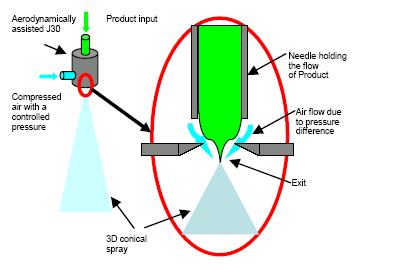
The VARJ30 is the aerodynamically assisted jetting equipment showed on the figure below. The product enters through a central needle. The exit orifice, which is centrally in line with the axis of the needle, has been counter sunk externally. The counter sunk leads to the aero dynamical effect that the jet has the smaller diameter when it is passing the orifice than the needle. The needle is enclosed in a pressure chamber with an exit through the orifice. The size of the drops is determined by the product flow rate and the pressure inside the chamber. The product flow rate is typically controlled by a hyprecision syringe to be connected to the product nozzle. The pressure in the pressure chamber is controlled by the Nisco Pressure controller. The pressure sensor is installed in the HMI* control console. The pressure set-point can be entered via touch screen.
* HMI – Human Machine Interface
 |
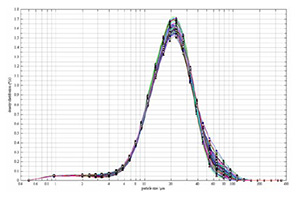 |
| Principle of aerodynamically assisted jetting | Typical bead distribution: The beads were made with the nominal sized unit of 350μm, resulting peak at 20μm |
For commercial applications, check publications and patents on the technology (see next page).
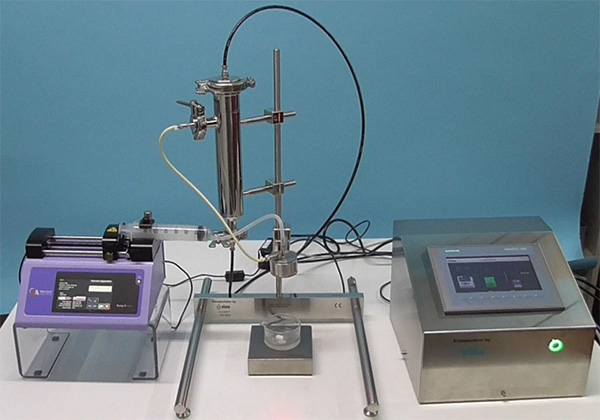
The bead generator with coaxial airflow is made of stainless steel 1.4435 (equivalent 316L) and can withstand most chemicals and high temperatures, which make the unit very suitable for any disinfecting/cleaning method including autoclave cleaning. As gaskets O-rings made of EPDM are delivered. For pharmaceutical or medical applications the required material certificates are available.
The VARJ30 is supplied two nozzle sizes, (available 100, 150, 200,250, 350, 400, 500, 600, 700, 800, 900, 1000mm). This unique technology has the following advantages: The reachable smallest particle is approximately 1:10 smaller than the needle diameter, depending on the physical properties of the product and the requirements in regard of the particle homogeneity even smaller. So you can achieve very small particles with a minimised danger of clogging.
So near homogenous particles around 10 micrometer are now in the reach with the VARJ30Continuation
Encapsulation Unit – VARJ30
The technology as it is applied in our VARJ30 has been published 1980 by Prof. Peter Walzel 1980.
The concept of flow focussing was there since the dates going back to as far or even or further back to the 1960's.
1968:
LLoyd Spielman and Simon L. Goren
Improving Resolution in Coulter Counting by Hydrodynamic Focusing
Department of Chemical Engineering, University of California, Berkley
Journal of Colloid and Interface Science 26, 176-182
1983
The concept has since been used heavily in the cytometry industry. Just to mention one example:
US Patent 1983 4,408,877
vice for hydrodynamic focussing of a particle-suspension in a liquid flow cytophotometer
1980
P. Schmidt and P. Walzel,
Zerstäuben von Flüssigkeiten
Chem.-Ing.-Tech, 52 (1980) Nr. 4, S. 304-311.
1990
P. Walzel,
Zerstäuben von Flüssigkeiten
Chem.-1ng.-Tech. 62 (1990) Nr. 12, S. 983-994
VCH Verlagsgesellschaft mbH, D-6940 Weinheim, 1990
1997
A.M. Ganan Calvo and A. Barrero
A Novel Pneumatic Technique to Generate Steady Capilary Microjets
Aerosol Sci Vol 30, No. 1 pp. 118-125 1999
Since 1997 there were a lot of publications by various authors.
There are also numerous current patents on the field of flow focussing. They were all published later than the articles listed above.
For example, US Patent 619953 by University Seville followed by numerous patents the following years.
 Please use the Info-Form to ask for the adequate encapsulation system for your specific applications.
Please note: You need Acrobat reader to display the following PDF - Files.
 |
Download 191116_EncapsJ30_E as PDF file |
|
Download 260609_J30 with two flasks_standard as PDF file |